

What is an orbit?
An orbit is the curved path that an object in space (such as a star, planet, moon, asteroid or spacecraft) takes around another object due to gravity.
Gravity causes objects in space that have mass to be attracted to other nearby objects. If this attraction brings them together with enough momentum, they can sometimes begin to orbit each other.
Objects of similar mass orbit each other with neither object at the centre, whilst small objects orbit around larger objects. In our Solar System, the Moon orbits Earth, and Earth orbits the Sun, but that does not mean the larger object remains completely still. Because of gravity, Earth is pulled slightly from its centre by the Moon (which is why tides form in our oceans) and our Sun is pulled slightly from its centre by Earth and other planets.
During the early creation of our Solar System, dust, gas, and ice travelled through space with speed and momentum, surrounding the Sun in a cloud. With the Sun being so much larger than these small bits of dust and gas, its gravity attracted these bits into orbit around it, shaping the cloud into a kind of ring around the Sun.
Eventually, these particles started to settle and clump together (or ‘coalesce’), growing ever larger like rolling snowballs until they formed what we now see as planets, moons, and asteroids. The fact that the planets were all formed together this way is why all the planets have orbits around the Sun in the same direction, in roughly the same plane.
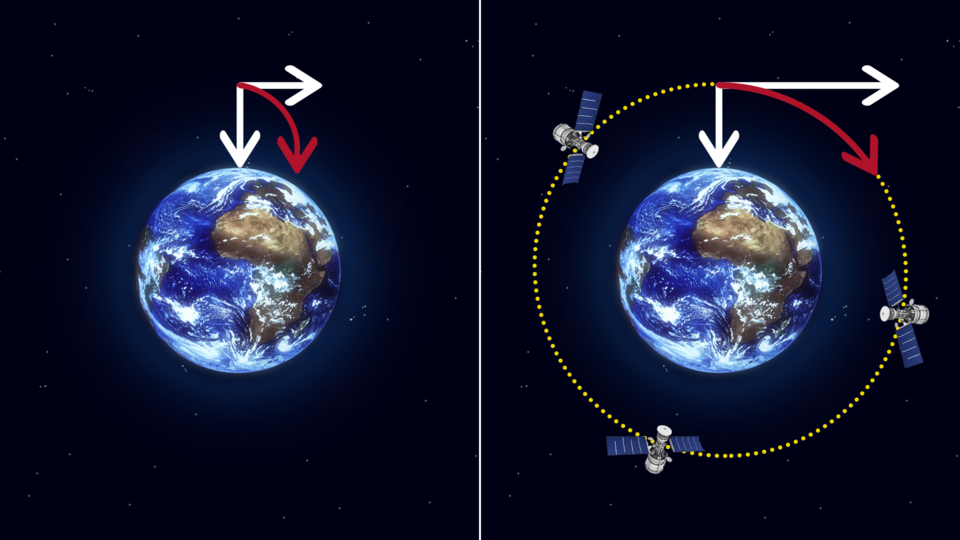
When rockets launch our satellites, they put them into orbit in space. There, gravity keeps the satellite on its required orbit – in the same way that gravity keeps the Moon in orbit around Earth.
This happens in a way that is similar to throwing a ball out of the window of a tall tower – to get the ball going, you need to first give it a ‘push’ by throwing it, making the ball fall towards the ground on a curved path. Whilst it is your throw that gives the ball its initial speed, it is gravity alone that keeps the ball moving towards the ground once you let go.
In a similar fashion, a satellite is put into orbit by being placed hundreds or thousands of kilometres above Earth’s surface (as if in a very tall tower) and then being given a ‘push’ by the rocket’s engines to make it start on its orbit.
As shown in the figure, the difference is that throwing something will make it fall on a curved path towards the ground – but a really powerful throw will mean that the ground starts to curve away before your object reaches the ground. Your object will fall ‘towards’ Earth indefinitely, causing it to circle the planet repeatedly. Congratulations! You have reached orbit.
In space, there is no air and therefore no air friction, so gravity lets the satellite orbit around Earth with almost no further assistance. Putting satellites into orbit enables us to use technologies for telecommunication, navigation, weather forecast, and astronomy observations.